
Listen: on our site, PRX, Mixcloud — full track list
This episode is dedicated to Russ Arlotta of Takoma Park, Maryland, who began work on the album Home in 2024 and did not live to see it released. His friends completed it and sent it out into the world in 2026, and the closing track, “Turning Tide,” closes with a word that also serves as the album’s title — Home — repeated like a mantra, like a prayer, like an answer that has been waiting all along. It is from that word, and from that vision, that this episode takes its shape.
We segue naturally to Psmyth & Co., the enigmatic Penzance-based project whose track “Home” appears on the album One Day on Earth, released in June 2026. PermaPiano of Madrid follows with “S.Federici,” a brief, meditative piano piece from the album DECR — a title alluding to décroissance or degrowth. New Gaia offers a sardonic interlude with “Home Simulator,” from their self-titled concept album on Ailanthus Recordings — a vaporwave vision of a humanity so thoroughly self-destructive that the planet has been officially condemned, and the survivors are being shuttled off to off-world colonies. Jarod K. Anderson of Ohio shares thirty seconds of spoken word, the poem “Home” from his collection Field Guide to the Haunted Forest. Peter Power of Brazil follows with “The Homesome Wanderer” from his 2024 album The Sound of Home — homesome being a rare and perhaps archaic dialect word, meaning that particular fullness of being at home, or longing for it. Casey Ní Bhreathnach of Ireland offers an unreleased poem, “Home Is Gold,” which travels from the banks of the Himalayas — where she plays the flute for the water spirits — back to Ireland, where she longs to remain, closing with the Irish proverb Ach níl aon tinteán mar do thinteán féin: there is no place like home. And Gus Greene of New York City rounds out the first half with “Builder,” from his February 2026 album Times of Change on Oak Tree Records — a track with a mystical, English-folk-inflected nature vibe.
Beneath Bart’s remarks lies a field recording made during a morning meditation session on the front steps of co-host Laura’s home in Bloomington, Indiana.
The second half opens with a brief digression into the world of contemporary sculpture: a new monumental bronze work by Bharti Kher, unveiled at the Victoria and Albert Museum in London, depicting a female warrior figure with a colorfully decorated house on her head — nearly thirteen feet tall and titled Gaia. (See for yourself on the museum website.)
Spell Songs — the folk collective convened in support of the nature writing of Jackie Morris and Robert Macfarlane — released their new album In Thin Air on Hudson Records on the 4th of September, and we feature the track “Senegal”: a meditation on what home means to a migratory bird crossing continents. You keep on moving, you call it home. The community chorus project Sea Others Glow of Minnesota offers the gentle choral question “Where Does Your Heart,” from the compilation released in January 2026, and you will know the answer before the song is done. (Props to the songwriter, credited only as J.K.; catch her interview.) Ihme ja Kyllä of Finland bring “Kotiin, kaikessa rauhassa” — “Home, in peace” — a single from November 2025. Robert Cabrera of Venezuela sings “A Mis Raices” — “To My Roots” — from his album en Gratitud, a song about the ache of emigration: looking down from the airplane window at the beauty of his country’s rivers and open plains. George Eretikovsky of Russia sings “Наша Земля” (Nasha Zemlya) — “Our Earth” or “Our Land” — a phrase that can mean a patriot’s homeland or the planet we all share. And Aloka of Hawaii brings the episode home, so to speak, with “Earth Tribe” from the 2016 album North Star.
And so the episode ends where it began: in the knowledge that we share one home, that it is worth protecting, and that — in the words of Russ Arlotta — love, patience, and kindness are what will take us there.
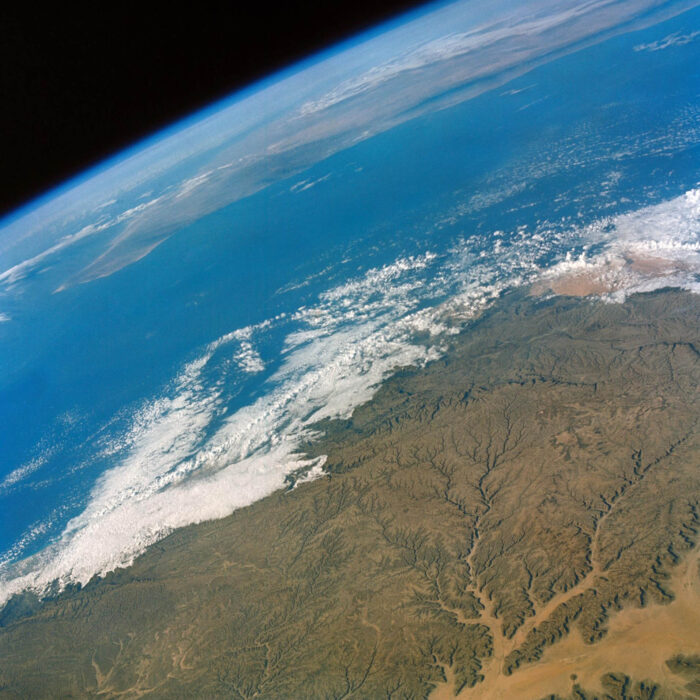
Photo: The featured image was taken by the Gemini-4 spacecraft and depicts the Hahramaut Plateau on the southern portion of the Arabian Peninsula. This is from 1965, and yes, it was shot on film. Thanks, NASA!
Discover more from Earth Eclectic
Subscribe to get the latest posts sent to your email.