
Listen: on our site, PRX, Mixcloud — full track list
Host Laura Dedelow opens with a personal reckoning. Friends and family are being rescued by boat from flooded Indiana towns, evacuating Washington hillsides with goats, chickens, and a ball python, watching Reno’s horizon glow. She reaches for a metaphor: Gaia as a mammal fighting infection, the floods and fires as fever and inflammation, the planet’s immune system surging toward a crisis point. It sets the emotional register immediately — not despair exactly, but something close to awe.
A note added in the wake of broadcast: As this episode was being prepared, the news from Nepal arrived too late for Laura’s recording, but it could not go unacknowledged here. On August 26, 2026, a massive glacier collapse on Langtang Lirung peak near the Nepal-China border sent an avalanche of ice, rock, and debris thundering into the Lhende Khola, a tributary of the Bhote Koshi River. The resulting flash flood killed hundreds of people, left over a thousand missing, including foreign pilgrims and tourists, and erased entire communities within minutes. Scientists at the National Snow and Ice Data Center and elsewhere have been unequivocal: there is no question that this event was made more likely by climate change. The warming of the Himalayas, heating faster than most regions on Earth, is destabilizing glaciers and the bedrock beneath them, turning the “abode of snow” into a source of cascading hazards: glacier collapse, debris flow, river blockage, catastrophic flood. The same valley had been struck by a glacial lake flood as recently as 2025. “More and more disasters are coming,” said glaciologist Mohan Bahadur Chand of Kathmandu University. Laura’s opening image — Gaia as a mammal fighting infection, floods and fires as fever and inflammation — finds its most harrowing illustration yet in the brown and debris-choked waters of the Trishuli River, visible in satellite imagery taken the morning after. We hold Nepal in our thoughts, and we let the music speak.
The Gaylads of Jamaica open the music with their rocksteady cover of James Taylor’s “Fire and Rain,” originally recorded around 1970 and reissued in 2025 — a quietly radical act of Caribbean reinterpretation, taking a song of personal loss and grief and giving it a new, swaying, communal body. Beneath Laura’s opening remarks, Celia Hollander of Los Angeles offers “Fire / Water” from her album Perfect Conditions, described as a tribute to elemental combinations and the precise conditions that make life on Earth possible — a meditation that is itself a kind of counterpoint to the episode’s anxieties.
Angélique Kidjo, born in Ouidah in what is now Benin, delivers “I’m on Fire” featuring The Cavemen, from her album HOPE!! Jah Wobble & Tian Qiyi follow with a cover of the Beatles’ “Rain,” drawn from Mystic Liverpool: The Beatles Psychedelic Psongbook, filtering a familiar classic through something strange and ancient. Katy Taylor of Port Townsend, Washington, then invokes Brigid, Celtic goddess of fire, with her devotional title track from Welcome Brigid. PAWL follows with “Rising Water,” and Ian Cumpstey of London delivers the title track from High Water Rising — two artists, two takes on the same swelling dread. Jack’s Rake of Sheffield close the set with the title track from their album Wildfires, bringing a Celtic folk urgency to bear on the burning landscape. Threading beneath Laura’s mid-episode talk is Brian Jackson‘s “Mami Wata,” from the Joaquin Joe Claussell Sacred Rhythm and Cosmic Arts Remixes album — Mami Wata being the formidable water spirit of Caribbean and African spiritual traditions, her presence here quietly consecrating the episode’s elemental theme.
The final stretch turns more explicitly toward the sacred. ILM of Genoa, Italy, offers a cover of Johnny Cash’s “Five Feet High and Rising,” from the tribute album Johnny Cash Is a Friend of Us — a song that gains new and unsettling relevance with every passing flood season. Tabby Diamond — Donald “Tabby” Shaw — of Jamaica delivers “This World (Is Going Up in Flames)” in the reggae tradition that has always understood apocalypse as both warning and lament. Then the Voudou lwa take the stage: Erol Josue of Port-au-Prince, priest, singer, actor, choreographer, and Director of Haiti’s National Bureau of Ethnology, performs “Erzulie” from his album Peleri-naj — Erzulie being the lwa of water, beauty, and love. Hawthorn Wellington Quashie, aka King Wellington of Goodwood, Tobago, answers with “Shango,” originally released in 1977 and reissued by Soundway Records — Shango being the lwa of fire, thunder, and justice, his counterpart in this elemental liturgy. Beneath Laura’s closing talk, Lava Lagoon — the project of Marco Calderone — offers “Pele’s Dance,” a single honoring Pele, the Hawaiian goddess of volcanic fire, extending the episode’s devotional geography from the Caribbean to the Pacific.
Cindertalk — the project of Jonny Rodgers of Portland, Oregon — closes the episode with “Rising Water,” drawn from the original soundtrack of Moving Water, a play about humanity’s relationship to water in the age of climate change. It is a quietly devastating act of sustained listening — which is, perhaps, what the planet is asking of us.
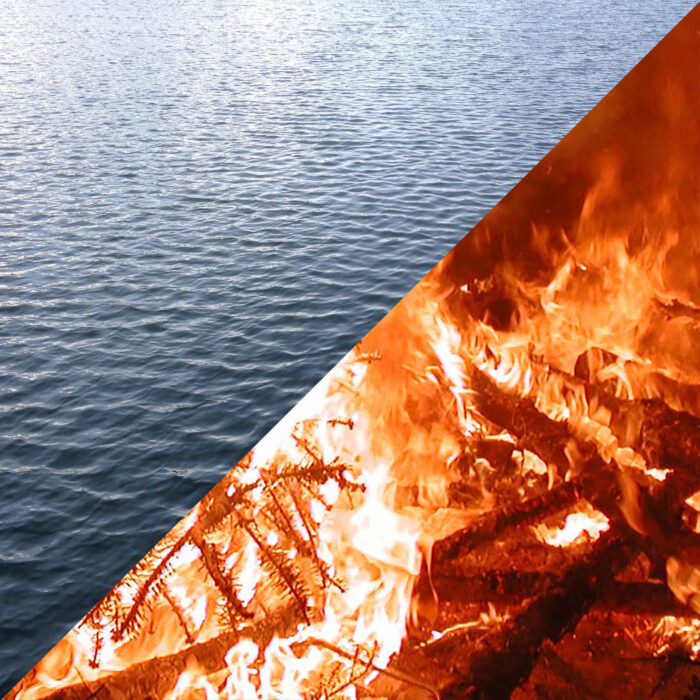
Photo: If it looks familiar, that’s because it’s a remix combining two featured photos, both by Bart Everson, from “elemental” episodes 0079 and 0080.
Discover more from Earth Eclectic
Subscribe to get the latest posts sent to your email.