
Listen: on our site, PRX, Mixcloud — full track list
We open with Laura McCarthy‘s “The Rutted Earth,” a haunting meditation from County Cork on the relentless machinery of modern Irish agriculture. “Barely a day goes by,” she writes, “that I don’t hear a rock breaker or see a digger hacking at rocky outcrops.” Her song transmits that anguish to great effect, weaving in a lullaby associated with the Sluagh Sidhe, as if calling upon the old spirits to take notice. England’s Pagan Harvest continues the critique with “Push the Plough,” a progressive rock indictment of industrial farming — monocultures, chemical rain, genetic crops — the language escalating steadily toward the apocalyptic. Beth Sage of Hanover, Kansas, brings a more intimate folk register to the same crisis in “Get Big or Get Out,” examining the grinding pressure that corporate agricultural interests exert upon individual farmers and the land they tend.
But we don’t dwell in despair. Crow Women of Durango, Colorado, offer the “Garden Harvest Song,” a choral piece written for ritual use during the harvest season, giving thanks to Gaia, the Green Man, and the spirits of the land for the bounty of vegetables, fruits, grains, “peas and ‘taters.” Simon Purchase James of Philadelphia lightens the mood further with “Dirt,” a winningly witty track from his Garden EP, in which the narrator envies a woman’s devoted attentiveness to her garden — and wishes, not without a certain earthy eroticism, that she might lavish upon him the same tender care she gives her soil. The Invisible Bee of San Francisco closes the first half with “The Plant Based Treaty Song,” a spirited activist anthem. Did you know there’s a movement? Check out PlantBasedTreaty.org.
Threading under Bart’s commentary on the first half is a field recording by Polish artist Michał Biel, an excerpt from “An Old Settlement and the Watering Hole,” drawn from the compilation 14 Soundscapes on Biodiversità Records. Recorded at the ruins of an old settlement on the Drwęca River at dawn, the sounds of cows coming to drink provide an ancient, unhurried counterpoint to the urgency of the music.
The second half turns toward Indigenous and multilingual voices. The Ensamble de Percusiones Usach of Santiago, Chile, performs “Madre Luna” — or “Kuyen Ñuke,” as it is titled in Mapudungun, the language of the Mapuche people — a poem by the celebrated poet Elicura Chihuailaf set to music by Pablo Espinoza. The Moon here is keeper of the agricultural calendar, entrusted by Genechen with the fertility of the Earth: a vision of cosmic reciprocity. Sil Sol, an Italian artist singing in Spanish, follows with “Chakra es Alimento,” inspired by the traditional knowledge of the Kichwa people — chakra meaning not merely a plot of land but a living system of food, medicine, craft, and spiritual practice. Birch of Barcelona sings “Terra Mullada” (“Wet Earth”) in Catalan, a lament for a landscape of olive trees and fenced-off fields, in which the speaker’s grief sinks into the sodden earth and is quietly transfigured. From Argentina, Manchula offers the brief, devastating “Tierra Seca” (“Dry Earth”), in which a singer waters a struggling plant with her own tears during a drought under a changing climate.
Dalton Alexander of Whitehorse, Yukon, provides a passage of quiet, ambient mourning with “Willow Farm Pond,” a field-inflected elegy for his recently-sold childhood home. We end by reaching back in 2019 with Wendy Rule‘s “Oh Golden Grain.” Part of her song-cycle on the myth of Demeter and Persephone, it reminds us that the grief of the harvest and our hunger for land are among the oldest stories we know.
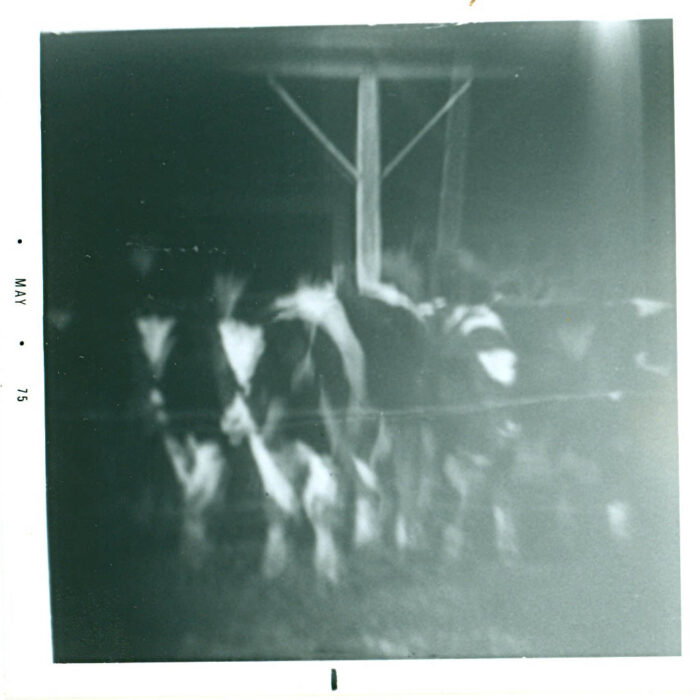
Photo: Bart took this pinhole photo of cows on his grandparents’ farm when he was seven years old.
Discover more from Earth Eclectic
Subscribe to get the latest posts sent to your email.