
Listen: on our site, PRX, Mixcloud — full track list with links
This week on the Earth Eclectic Radio Hour, host Bart Everson offers a thematically unified contemplation of “Luminous Darkness,” the reciprocal relationship between light and shadow as experienced through the living world.
The episode opens with Rosemerry Wahtola Trommer, the Colorado poet who writes and publishes a poem every single day, reading “Teach Me the Dark” from her 2023 collaboration with guitarist Steve Law, Dark Praise — an album the artist describes as an exploration of “endarkenment,” all the ways darkness invites us toward revelation. It serves as a thesis statement for everything that follows.
Three moon songs come next: Heather Houston of Santa Cruz with the gentle “Moonlight Lullaby” from Shadows and Light; Lyft & Folde of Edinburgh, reflecting on “the soft tension where change begins” in the first quarter of the lunar cycle; and Kaleb Avery Fischer‘s choral “Black Daylight,” composed for the Sea Others Foundation community choir in Minneapolis and presumed to have been inspired by the 2024 total solar eclipse — darkness arriving in the middle of the day, as a gift. (There’s also a video.)
Then Alexandra “Ahlay” Blakely of Seattle brings “The Dark Times” from her Anthems for an Apocalypse, setting a 1939 poem by Bertolt Brecht — written in exile in Denmark as Europe darkened under fascism. The poem that asks whether there will also be singing in the dark times, and answers: yes, there will also be singing, about the dark times. Alexa Sunshine Rose of Port Townsend, Washington, follows with “Shining from the Forest.”
We return several times to Patrick Quinn‘s field recording “Balcony at Night,” a nocturnal soundscape captured in Cancún. The program then pivots into a set of Spanish-language songs, opening with Birch of Barcelona and “Luz en el Puerto” — light in the port, observed in a harbor that the artist describes as a strikingly legible symbol of fossil fuel civilization’s energetic metabolism. Caribano & Samantha Blanco of Caracas follow with “Pureza” from Lenguaje de las Plantas, a meditation on the sacredness of all life containing what Bart identifies as the episode’s key lyric: that darkness reveals itself solely through the light it radiates, and light shines forth solely through the darkness it conceals. Sil Sol, offers “Somos Luz” (We Are Light) drawn from the traditional knowledge of the Kamëntšá people of Colombia; and Sauljaljui, singing in Paiwan, the language indigenous to the mountain communities of Taiwan, closes the set with “Sapuy,” or Torch — a song born from the sight of a single firefly approaching a newly completed fire pit, and the memory of a mentor’s teaching: if we cannot be stars or the Moon, we should be fireflies, illuminating ourselves and those around us.
The nocturnal field recordings of French sound artist Bernard Fort — insects, amphibians, and a common nightingale in a Tuscan night — serve as the transition into two instrumental works: the collaborative “Cave of Light and Shadow” by Dashmesh of Phoenix, Erik Wøllo of Norway, and Byron Metcalf, from an album of the same name that treats the cave as a liminal space of initiation and transformation; and Lars Tellmann of Heilbronn, Germany, with the ambient “Light and Shadow” from his Komorebi Summerlight.
The program closes with a reach into the archive — a 2002 demo by Carved in Stone, recently re-released by Schwarzdorn Production after a long hiatus, “Nächtlicher Tanz” or Nighttime Dance, whose lyrics describe the gossamer white fog of the nocturnal forest as the dancing of fairies. It is the oldest track in the episode and perhaps the most enchanted — a reminder that the luminous darkness has been inhabited by human imagination for far longer than the ecological crisis that now makes it urgent.
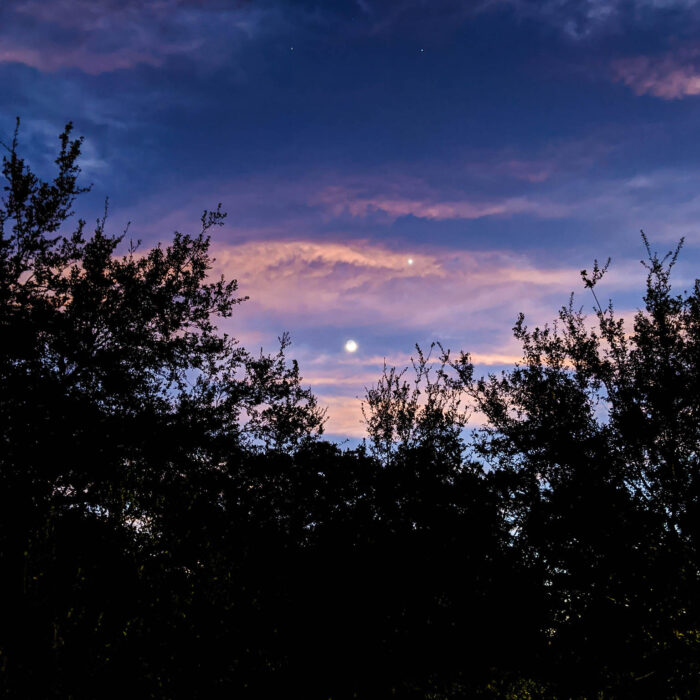
Photo: “Lights Before Dawn” by Bart Everson
Discover more from Earth Eclectic
Subscribe to get the latest posts sent to your email.