
Listen: on our site, PRX, Mixcloud — full track list
This week on the Earth Eclectic Radio Hour, host Laura Dedelow takes the listener on what she describes as a journey to the places we go to connect, ground, and commune — with other humans, with non-human beings, with spirit, with Gaia, and with whatever lies beyond.
The opening question is posed by Reverend Billy and the Stop Shopping Choir, that indefatigable gospel-inflected force of ecological and economic conscience: “Where Do I Go?” — and the episode proceeds to answer, track by track, with expansive geographical and spiritual range.
The New Orleans thread runs deep: Loren Pickford‘s jazz invocation of river spirits; Truckstop Honeymoon‘s “Magnolia Tree,” from a band now transplanted to the UK but still rooted in Louisiana soil; Tab Benoit and The Voice of the Wetlands All-Stars celebrating “Louisiana Sunshine” in a song that is as much lament as praise; and Dr. Michael White‘s traditional jazz rendering of “Down By The Riverside,” placing us at the water’s edge where the spiritual tradition has always known something waits.
Between and among these New Orleans returns, Laura navigates extraordinary territory: the Sant Andreu Jazz Band of Barcelona offering their own longing for green grass and home; Peter Mayer of Stillwater, Minnesota, whose gentle folk meditation “The Evermore” suggests that the sacred is not a place we visit but a presence we carry; Alexandra “Ahlay” Blakely of Seattle, whose “All the Places” from Anthems for an Apocalypse names the theme with unambiguous directness; and Cedar Waxwing of Berkeley, California, finding in “Live Oak Park” the kind of local, specific, rooted place that Stephan Harding might call a Gaia place — a point of genuine contact between a human life and the Living Earth.
It is Harding himself, or rather his words from Gaia Alchemy: The Reuniting of Science, Psyche, and Soul, who provides the episode’s conceptual center, in an excerpt titled “Your Gaia Place” read aloud by co-host Bart Everson — the idea that each of us has a particular place on the living planet where the relationship between self and Earth becomes most vivid and most real.
Patti Page and June Carter Cash arrive from the archive — “Mockingbird Hill” and “Church in the Wildwood,” respectively — reminding us that the country music tradition has always known that the sacred place is often outdoors, often birdsong-haunted, and never quite the church building itself.
Pigeon John brings “Rocky Mountain High” into the hip-hop register, reinhabiting the John Denver anthem from the unlikely vantage of Los Angeles. And Laibach, the Slovenian neo-classical collective, offer their characteristically estranging version of “The Sound of Music”: the hills, after all, are alive — and in this context, that is not sentimentality but ecological fact. Throughout, Harmony Meadow‘s field recordings from Muir Woods serve as a ground beneath the ground, the old-growth coastal redwood forest itself breathing beneath the music, the oldest living presence in the mix.
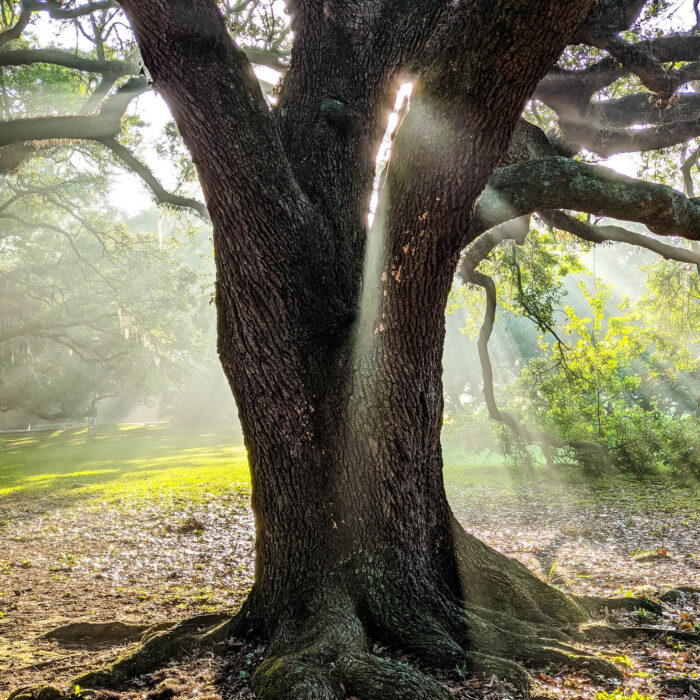
Photo: “Glory Oak” by Bart Everson.
Discover more from Earth Eclectic
Subscribe to get the latest posts sent to your email.