
Listen: on our site, PRX, Mixcloud — full track list with links
This week on the Earth Eclectic Radio Hour, host Bart Everson presents “Cicada Buzz” — a celebration of cicadas, buzzing insects, and the ancient, sacred noise of summer. The episode had its origin in a suggestion from Earth Eclectic’s self-proclaimed “number-one fan,” Erik Assadourian, who spotted a New York Times article about music inspired by cicadas and thought the program might find it useful.
It took over two years to arrive, but the timing was perfect: Dead Can Dance released “The Cicadas” on July 15th, as part of their 2026 monthly single series. The track is the latest entry in an ongoing series of Bandcamp-only monthly releases. Written by Brendan Perry, who also plays hurdy-gurdy and percussion, the piece features David Kuckhermann on bendir and riq, Yannis Pantazis on aulos, and the Rhodope Women’s Ensemble, recorded and mixed at the Temenos in Epidavros, Greece.
(Please don’t confuse Dead Can Dance with the Grateful Dead, who are more Laura’s bag than Bart’s. See previous episode. Bart names Dead Can Dance as perhaps his all-time favorite musical act, opening this episode with unconcealed delight.)
The mythology embedded in that opening track shapes the episode’s deepest logic. According to Plato, while resting outside Athens, Socrates and Phaedrus were surrounded by a loud chorus of cicadas, and Socrates told a tale that the insects were once men who loved singing so much that they sang until they died from forgetting to eat, and were reincarnated by the Muses. Now, after death, the cicadas return to the Muses to report on which mortals have honored them on earth — specifically, which humans dedicate their lives to philosophy, music, and divine discourse. An episode about cicada music is therefore, in the oldest sense, an act of devotion being observed and recorded.
The program alternates between songs, instrumentals, and poetry. Haiku, a duo of José Manuel Ortiz and Pedro Ramírez from Quito, Ecuador, with “Canto a las cigarras (movimiento 6),” — described as a melody that evokes the arrival of cicadas in the forest in the months of September and October. This is followed by ilyAIMY of Baltimore with “Cicada Summer,” spoken word poetry by Heather Aubrey Lloyd that moves through some of the cicada’s deeper mythology. Steph Richards, the avant-garde jazz trumpeter, offers “Sequoia: Cicada” from Zephyr on Relative Pitch Records; and then — an interlude of pure global pop — Lorde‘s “Solar Power” (2021), in which she incorporated cicadas she had recorded on her phone, a song that charted across the world.
An unnamed T’boli musician follows with “Call of the Cicada” — field recordings captured by Manolete Mora in 1995 among the T’boli people, whose ancestral lands surround Lake Sebu on the Philippine island of Mindanao. Bart then reads “The Sense of Cicada” by Bob Ambrose Jr., from his collection Journey to Embarkation (Parsons Porch Books, 2019) — noting how the poem’s cadence rises and falls like the insects themselves. Mecizand of St. Petersburg, Russia brings “Tyarlevo: shershenʹ” from Nature: Part One (2024), broadening the episode’s sonic taxonomy to include the hornet; and Léanie Kaleido (UK) offers “Mr. Dragonfly,” widening it further to the dragonfly — gorgeous, silent, a creature whose buzz exists only in the excitement of spotting one.
A middle section assembles more experimental and electroacoustic efforts: Douglas Lilburn of New Zealand with “Cicadas, Oscillators, and Tree Frogs” (1967), from his complete electro-acoustic works on Atoll Records — a piece in which the line between field recording and instrument is deliberately unclear; then “Cicadapalooza,” a short excerpt from the Princeton Sound Lab‘s nine-minute demonstration of the cicadas’ wall of sound, by Ananya Misra, Mary Wright, and Ge Wang. Threading throughout the show — audible as Bart speaks — are field recordings by Kokichi Yanagisawa, captured as he ascended and descended Mount Iizuna, a sacred mountain in Nagano, on June 1, 2026, using a BAROm1 microphone designed by Yasushi Utsunomia, with the cicadas of Japan in the background. Bart also inserts a brief Malaysian Rainforest Cicada field recording, serving a sonic anchors to the more-than-human world outside any studio.
The final movement opens with “Cicada Blues” by Tony Brewer, performed live at Vidwest Fest in Columbia, Missouri on April 18, 2026 — a poem written years earlier, possibly during the Brood X emergence in Bloomington, Indiana, in 2021. David Dunn and Hildegard Westerkamp offer the two-part medley “Village / Cricket” from the Dreams of Gaia compilation (Earth Ear, 1999); El Compost del Sistema of Puerto Madryn, Argentina, bring “Quiero ser tu insecto” (“I want to be your insect”) from Humusapiens (2024) — a love song for insects and their role in Gaia; and Tyler Damon closes with “Cicadas at the Door” from Softened Skull, originally released on cassette in an edition of one hundred on Auris Apothecary / Magnetic South, now available digitally.
The episode’s final track is the one that gave the episode its reason to exist: Bob Dylan‘s “Day of the Locusts” from New Morning (Columbia Records, 1970), inspired by the emergence of Brood X cicadas — the song that a New York Times writer noticed, that Erik Assadourian spotted, that set this whole two-years-in-the-making hour in motion. Take it away, Bob.
Social Media Update: At long last we’re on Mastodon. Follow us @eartheclectic@climatejustice.social
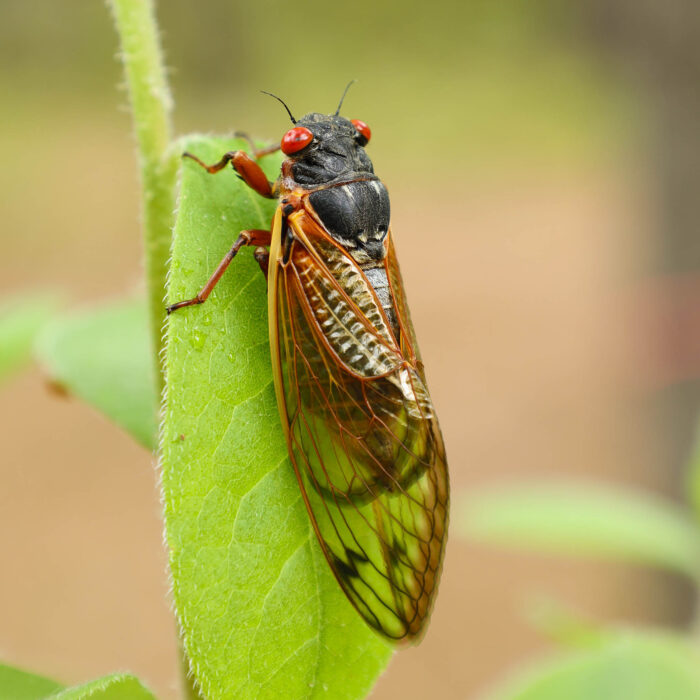
Photo: “Periodical Cicada adult” by Shane Harris for the Alabama Cooperative Extension System (ACES). This photo is in the public domain. We found it on Flickr.
Update: The good Humusapiens have apprised us there’s a music video for their song, made with fragments of The Hellstrom Chronicle (1971)!
Discover more from Earth Eclectic
Subscribe to get the latest posts sent to your email.